Stairpong Game by 155.io

Strategies, Mathematical Analysis & Betting Tips 2026

Every ball color in Stairpong carries the same mathematical edge for the house. The difference is how you manage variance, session length, and your own behavior. This guide breaks down the probability of each color, compares risk profiles, and gives you frameworks that actually extend playtime instead of promising impossible wins.

Base RTP 89.62% House Edge 10.38% Effective RTP 90.62–93.32% 106 Balls 5 Colors

Understanding the Mathematics

RTP (Return to Player) Explained

Stairpong Game by 155.io has a base RTP in Pick Winner mode of 89.62%. In practical terms, if you placed $1,000 in total wagers over hundreds of rounds, you would expect to get back approximately $896.20 on average. The remaining $103.80 is the casino's mathematical edge. This is a long-run statistical expectation, not a guarantee for any single session — short-term results can deviate significantly in either direction.

For comparison, most online slots have RTPs between 94% and 97%, and Plinko by the same studio (155.io) sits at approximately 97%. Stairpong's 89.62% is on the lower end of the spectrum, which is an important factor to acknowledge before building any approach around the game.

Stairpong RTP breakdown showing 89.62% base return to player and effective RTP with boosts
Stairpong RTP rules screen showing the 89.62% base return rate

House Edge Calculation

The house edge is simply 100% minus the RTP: 100% − 89.62% = 10.38%. This means for every dollar wagered across enough rounds, the house expects to keep roughly 10.4 cents. The edge is built into the multiplier payouts for each ball color — the multipliers are set slightly below what a "fair" payout would be given each color's probability of winning.

Expected Value Per Round

Expected value (EV) is the amount you can mathematically expect to win or lose per bet over time. For a $1 bet on any color in Stairpong:

EV = (Probability of Winning × Payout) − Bet = approximately −$0.1038 per $1 bet

This negative expected value applies to every color. White, Orange, Green, Blue, and Pink all carry the same house edge. The difference between colors is not the expected return — it is the variance. White wins frequently with small payouts (low variance). Pink wins rarely with massive payouts (extremely high variance). The average loss per dollar is the same.

Understanding this distinction between variance and expected value is the single most important concept for any Stairpong player. No color offers better long-term value than another — only a different risk profile. Your choice of color should match your bankroll tolerance, not a belief that one color "pays better."

Why "Hot Streaks" Are an Illusion

Each Stairpong Game by 155.io round is an independent physical event. The 106 balls are released fresh every race. Whether White won the last 5 rounds or lost the last 10 has zero statistical bearing on the next outcome. This is the gambler's fallacy — the mistaken belief that past results influence future independent events. The physical setup of Stairpong means there is no memory, no pattern, and no cycle. Treat every round as if it is the first one you are watching.

Ball Color Probability Analysis

Stairpong Game by 155.io uses 106 ping-pong balls distributed across 5 colors. Each color has a different number of balls, which directly determines its probability of winning any given round. The multiplier for each color is set by 155.io to create the 89.62% RTP. Here is the complete breakdown:

Color Ball Count Win Probability Multiplier EV per $1 Bet Variance Level
White 50 47.17% 1.90x $0.896 Very Low
Orange 37 34.91% 2.39x $0.834 Low
Green 10 9.43% 9.50x $0.896 Medium
Blue 5 4.72% 19.00x $0.897 High
Pink 1 0.94% 95.00x $0.893 Extreme

Reading This Table

The "EV per $1 Bet" column shows how much you statistically receive back for every $1 wagered on that color. All values hover around $0.89–$0.90, confirming that the house edge is roughly the same regardless of which color you pick. The slight variations between colors are due to rounding in the multiplier values. No color is mathematically "better" than another.

The 3 balls unaccounted for in common breakdowns (106 total minus 50+37+10+5+1 = 103) represent the probability margin where no clear winner from a single color emerges in certain edge-case race conditions. These are factored into the RTP calculation by 155.io.

What the Probabilities Mean in Practice

With White at 47.17%, you will lose roughly 53 out of every 100 rounds. That means even the "safest" color produces losing streaks of 3–5 rounds on a regular basis, and streaks of 8–10 losses are not unusual over a long session. For Pink at 0.94%, the average wait between wins is approximately 106 rounds. Some players go 200+ rounds without hitting Pink. These are not outliers — they are the mathematical reality of a sub-1% probability event.

Conservative Strategy (Low Risk)

Who This Is For

Players who want the longest possible session from a fixed bankroll. Entertainment-focused bettors who prefer steady action over chasing large wins. Beginners who are still learning the game mechanics.

Core Approach: White and Orange Flat Betting

The conservative strategy revolves around betting exclusively on White (1.9x) or Orange (2.39x). These two colors account for 87 out of 106 balls, giving you a combined win probability of roughly 82%. When betting on a single color, White hits approximately 47% of the time and Orange approximately 35%.

Use flat betting — the same bet amount every single round, regardless of whether you just won or lost. Flat betting prevents the emotional spiral of chasing losses with larger wagers, which is the number one bankroll killer in any casino game.

Session Parameters

  • Bet size: 1% of your session bankroll (e.g., $0.50 bets with a $50 bankroll)
  • Color selection: White (1.9x) for maximum hit rate, or Orange (2.39x) for slightly larger wins with slightly lower frequency
  • Stop-loss: End your session if you lose 40% of your starting bankroll
  • Take-profit: Walk away at 20% above starting bankroll
  • Time limit: Maximum 60 minutes per session regardless of results

Expected Session Length

With $50 and $0.50 flat bets on White, you have 100 bet units. Due to the ~47% win rate with 1.9x returns, your bankroll will fluctuate but drain slowly. Most sessions last between 150 and 300 rounds before hitting the 40% stop-loss. At roughly 2 minutes per round, that is 5–10 hours of playtime — solid entertainment value for the money.

Limitations

You will never hit a massive win with this approach. The best single-round outcome is 1.9x your bet. Sessions will often feel like a slow grind downward with occasional small boosts. The house edge still applies — over enough sessions, you will lose. This strategy extends playtime but does not eliminate the mathematical disadvantage.
Moderate Strategy (Medium Risk)

Who This Is For

Intermediate players comfortable with higher variance who want the possibility of meaningful wins without extreme risk. Players who find pure White/Orange betting too slow-paced and want more excitement.

Core Approach: Green-Focused with White Anchor

Green balls (9.5x multiplier) represent a middle ground: they appear frequently enough to hit several times per session (roughly once every 10–11 rounds), yet the payout is large enough to recover from short losing streaks. The moderate strategy uses Green as the primary bet color, with a portion of the bankroll allocated to White as a safety anchor.

Allocation Model

  • 70% of each round's bet on White (1.9x) — this creates a steady trickle of returns that slows bankroll depletion
  • 30% of each round's bet on Green (9.5x) — when Green hits, the 9.5x payout on 30% of your bet more than compensates for the rounds where only White wins
  • Total bet per round: 2% of session bankroll (e.g., $1.00 total with a $50 bankroll, split $0.70 White / $0.30 Green)
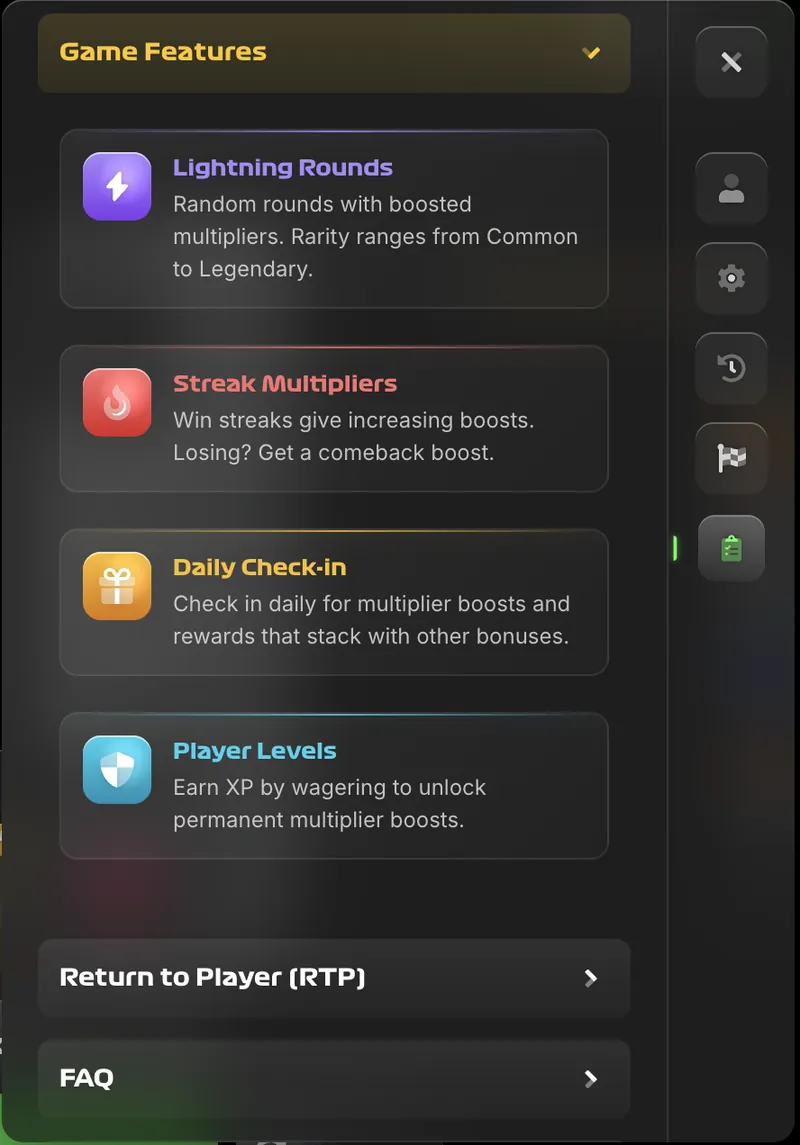
Stairpong game features overview showing ball colors, multipliers, and betting modes
Game features overview

How It Plays Out

In a round where White wins: you receive $0.70 × 1.9 = $1.33, losing $0.30 on Green. Net result: +$0.33.

In a round where Green wins: you receive $0.30 × 9.5 = $2.85, losing $0.70 on White. Net result: +$1.85.

In a round where neither wins (Blue or Pink wins): you lose the full $1.00. This happens roughly 5.7% of the time.

Session Parameters

  • Stop-loss: 50% of starting bankroll
  • Take-profit: 40% above starting bankroll
  • Time limit: 45 minutes per session

Limitations

Green only hits about 9.4% of rounds. You will experience stretches of 20–30 rounds without a Green win, during which your bankroll erodes from the losing Green bets even when White keeps hitting. The combined house edge still applies to both bets independently. This approach increases volatility compared to pure conservative play while offering more satisfying individual wins.

Aggressive Strategy (High Risk)

Who This Is For

Experienced players with a defined entertainment budget who accept that they will likely lose it all in exchange for the chance of hitting a large multiplier. This is a high-variance approach that produces long losing streaks punctuated by significant payouts.

Core Approach: Blue and Pink Allocation

Blue (19x, ~4.72% chance) and Pink (95x, ~0.94% chance) offer the largest payouts in Stairpong. The aggressive strategy dedicates a meaningful portion of each round's bet to these high-multiplier colors while maintaining a small White position to slow the bleed during dry stretches.

Allocation Model

  • 50% on White (1.9x) — bankroll preservation layer
  • 30% on Blue (19x) — the primary upside target
  • 20% on Pink (95x) — the moonshot allocation
  • Total bet per round: 2–3% of session bankroll maximum

How It Plays Out

When White wins (47% of rounds): you get 1.9x on 50% of your bet but lose the Blue and Pink portions. Net result on a $1 total bet: $0.50 × 1.9 − $0.50 = −$0.05. Essentially break-even.

When Blue wins (4.7% of rounds): you get 19x on 30% of your bet. On a $1 bet: $0.30 × 19 = $5.70, minus $0.70 lost. Net: +$5.00. A single Blue win covers roughly 100 break-even White rounds.

When Pink wins (0.94% of rounds): you get 95x on 20% of your bet. On a $1 bet: $0.20 × 95 = $19.00, minus $0.80 lost. Net: +$18.20. One Pink hit resets your entire session.

Session Parameters

  • Stop-loss: 100% of session bankroll (accept the full loss as the entertainment cost)
  • Take-profit: Walk away immediately after any Blue or Pink win, or at 100% gain
  • Time limit: 30 minutes maximum — aggressive play is mentally exhausting

Limitations

Blue hits roughly once every 21 rounds. Pink hits roughly once every 106 rounds. You will go entire sessions without hitting either. The expected loss per dollar is still ~$0.104 regardless of allocation. This strategy amplifies variance, not expected value. Many sessions will end at the stop-loss. The occasional large win creates an emotional high that can lead to chasing behavior — which is why the "walk away after a big hit" rule is non-negotiable.

Bankroll Management

Bankroll management is the single most impactful thing you can do when playing Stairpong. It does not change the odds, but it determines whether you walk away after a fun session or spiral into chasing losses. Every professional gambler, sports bettor, and poker player will tell you the same thing: discipline with money matters more than any betting strategy.

The 1% Rule

Never risk more than 1–2% of your total gambling bankroll on a single Stairpong round. If your bankroll is $100, your maximum bet per round should be $1–$2. This rule exists because even the highest-probability bet (White at 47%) will produce losing streaks. With 1% bets, you can absorb a 10-round losing streak and only be down 10% of your bankroll. With 10% bets, that same streak wipes you out.

Session Bankroll 1% Bet Size 2% Bet Size Approx. Rounds (White) Session Duration
$10 $0.10 $0.20 150–300 1–2 hours
$25 $0.25 $0.50 150–300 1–2 hours
$50 $0.50 $1.00 150–300 1–2 hours
$100 $1.00 $2.00 150–300 1–2 hours

Setting Session Limits

Before you open Stairpong Game by 155.io, decide three things and write them down:

  1. How much money am I willing to lose this session? This is your session bankroll. Transfer only this amount to your casino account balance. Do not add more mid-session.
  2. At what profit do I walk away? A reasonable take-profit target is 20–40% of your session bankroll. If you started with $50 and reach $65, close the tab.
  3. How long will I play? Set a timer. Even if you are up, stop when the timer goes off. Extended sessions lead to fatigue, which leads to poor decisions.

Stop-Loss Discipline

The stop-loss is your hard floor. When your session bankroll drops to this level, you stop. No exceptions. No "one more round." The most dangerous moment in gambling is right after hitting your stop-loss, because the emotional urge to recover is strongest. Closing the browser or app is the correct play every single time.

Practical Tip: Use Casino Deposit Limits

Most casinos that host Stairpong (Stake, Gamdom, Roobet) offer deposit limit features. Set a daily or weekly deposit limit that matches your entertainment budget. This creates a hard barrier that prevents impulsive top-ups during a losing session. You can find these settings in the responsible gaming section of your casino account.

Emotional Control

Two emotional states destroy bankrolls faster than any house edge: tilt (frustration after losses) and euphoria (overconfidence after wins). After a losing streak, your brain wants to increase bet sizes to "win it back." After a big win, your brain tells you that you are on a hot streak. Both instincts are wrong. The odds have not changed. Your bet size should not change either. Flat betting solves this problem mechanically — you cannot tilt-bet if your bet size is fixed.

Using Game Features to Your Advantage

Stairpong has several built-in features that can improve your effective RTP. Unlike the ball color you choose (which does not change the house edge), these features genuinely shift the math in your favor when active. Understanding them is the closest thing to a real strategic advantage in Stairpong.

Lightning Rounds

Lightning Rounds are randomly triggered events where the multipliers for all ball colors receive a temporary boost. During a Lightning Round, the effective RTP increases because the payouts are higher while the probabilities remain the same. The strategic implication is straightforward: always have enough bankroll remaining to place a bet during Lightning Rounds. If you have burned through your session bankroll before a Lightning Round appears, you miss the best risk-reward opportunity in the game.

This is another argument for conservative bet sizing — smaller bets early in a session preserve your bankroll for the higher-value Lightning Round bets later.

Streak Multipliers

Streak Multipliers reward consecutive correct predictions with increasing payout boosts. The mechanic is designed to increase engagement, but it also creates genuinely better odds during an active streak. The catch: streaks are hard to build. With White's 47% win rate, the probability of hitting 3 consecutive White wins is roughly 10.4% (0.47 × 0.47 × 0.47). The probability of 5 in a row drops to about 2.3%.

Do not change your bet sizing to "protect" a streak or "build" one. Streaks are retrospective labels we put on sequences of independent events. Bet consistently and let streaks happen naturally. When they do, the boosted payouts are a genuine mathematical bonus.

Daily Check-in Boosts

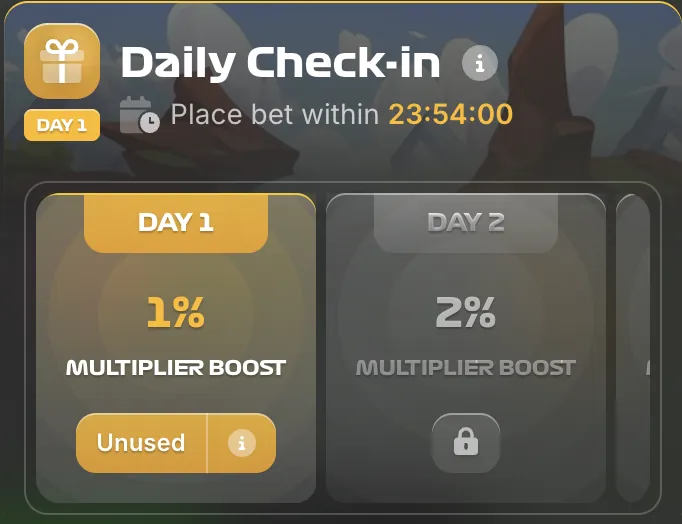
155.io offers daily check-in rewards that include free bets and multiplier enhancements. Free bets are pure positive expected value — you risk nothing and can win real money. Log in daily to collect these, even on days when you do not plan to play a full session. Over time, these free bets accumulate into meaningful value that partially offsets the house edge.

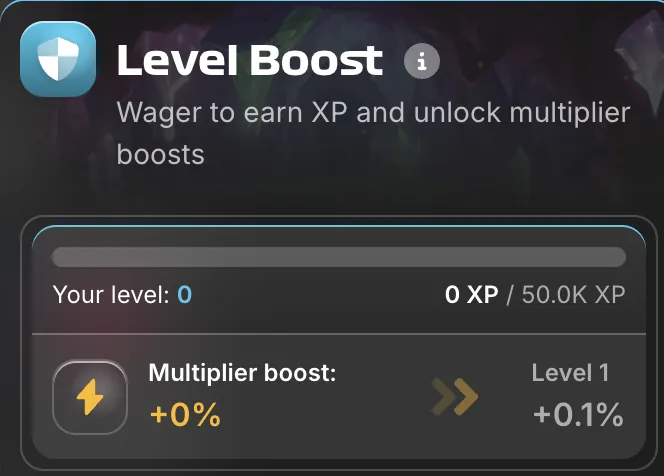
Stairpong player level boost showing XP progression and multiplier rewards
Player Level system with XP and multiplier boosts

Player Level Boosts

As you play Stairpong, you earn XP that increases your Player Level. Higher levels unlock permanent multiplier boosts that apply to all future bets. These boosts can raise the effective RTP from the base 89.62% up to 93.32% at maximum level with all boosts active. This is a significant improvement — the house edge drops from 10.38% to about 6.68%, which is much closer to industry-standard RTP levels.

The strategic angle: Player Level rewards consistent, long-term play over sporadic high-stakes sessions. Players who bet smaller amounts over many sessions will accumulate XP faster (relative to their bankroll risk) than players who make a few large bets and leave. This further supports the conservative approach.

Stairpong daily check-in rewards showing multiplier boosts and free bets
Daily check-in rewards with multiplier boosts

Stairpong vs Other 155.io Games

155.io (also known as Marbles.io) operates several live physics-based games. If your primary concern is strategy and expected value, it is worth comparing Stairpong against its siblings to see which game fits your preferred risk profile.

Feature Stairpong Plinko Snake Rolling Dunes Marble Race Evo
Type Ball race (stairs) Ball drop (pegs) Snake race Marble roll Marble race
Base RTP 89.62% ~97% ~90–93% ~90–93% ~90–93%
Max Win 95x 1,000x ~50x ~50x ~50x
Bet Options 5 colors Risk level (L/M/H) Color/position Color/position Marble selection
Volatility Medium-High Adjustable Medium Medium Medium-High
Live Physical Yes Yes Yes Yes Yes
Booster System Yes (up to 93.32%) Limited Yes Yes Yes
Strategy Depth Color selection + bankroll Risk level + rows Position analysis Lane analysis Marble stats

Bottom Line

Plinko offers significantly better base RTP (~97% vs 89.62%) and higher max win potential (1,000x vs 95x). If pure mathematical advantage is your priority, Plinko is the objectively better game within the 155.io ecosystem. Stairpong's appeal is the communal race experience, the 5-color betting system that offers distinct risk tiers, and the booster system that can push effective RTP closer to competitive levels. For players who enjoy the spectacle and social aspect of watching 106 balls race live, Stairpong offers entertainment value that a single-ball Plinko drop cannot match.

For more details on how Stairpong compares to other casino games, see our full Stairpong review on the homepage.

Common Mistakes to Avoid

Mistake 1: Believing the Game Is "Due" for a Result

If Pink has not appeared in 200 rounds, it is not "overdue." Each round is independent. The 106 balls are physically released anew every time. There is no accumulating probability. Betting more because a color "should" hit soon is the gambler's fallacy in its purest form, and it will drain your bankroll faster than any other mistake.

Mistake 2: Increasing Bets After Losses (Martingale)

The Martingale system (doubling your bet after each loss) seems logical in theory but fails catastrophically in practice. Stairpong's $100 maximum bet creates a hard ceiling on progression. Starting with a $1 bet, you hit the limit after just 7 consecutive losses ($1, $2, $4, $8, $16, $32, $64 — the next step would be $128, which exceeds the cap). Seven consecutive losses on White has roughly a 2.5% chance per 7-round stretch, meaning it occurs approximately once every 40 stretches. Martingale does not change your expected value; it simply concentrates your losses into fewer, larger events.

Mistake 3: Ignoring the Booster System

Many players treat Stairpong as a pure gambling game and skip the Daily Check-in, level progression, and Multiplier Booster features. This is a missed opportunity. These features represent the only legitimate way to improve your mathematical position. The difference between 89.62% RTP and 93.32% RTP is substantial over hundreds of rounds. A player at maximum level with all boosts active keeps roughly $33 more per $1,000 wagered compared to a player who ignores the system entirely.

Mistake 4: Chasing Losses with Deposits

Your session bankroll should be deposited before you start playing. If you lose it, the session is over. Making additional deposits to "win it back" is the most reliable way to turn a planned $50 entertainment expense into a $500 problem. Use casino deposit limits as a mechanical barrier against this impulse.

Mistake 5: Playing Without Defined Exit Points

Starting a Stairpong session without a stop-loss, take-profit, and time limit is like driving without a destination. You will keep going until something goes wrong. Define your exit criteria before placing your first bet, and honor them without exception.

Mistake 6: Betting on Multiple Colors to "Cover" the Board

Some players bet on 3 or 4 colors simultaneously, thinking they are hedging their risk. In reality, you are just increasing the total amount wagered per round while the house edge applies to each individual bet. Betting $0.25 on all four colors except Pink means you wager $1.00 per round but only win back $0.48 (White), $0.60 (Orange), $2.38 (Green), or $4.75 (Blue) depending on the winner. The average return per round is still ~$0.896 per $1 wagered. You have not reduced your edge exposure; you have just complicated your betting.

Honest Verdict on Strategies

After analyzing every mathematical angle of Stairpong, the honest conclusion is this: Stairpong is a game of chance, and no strategy can turn a negative expected value into a positive one. The 10.38% house edge is baked into the multiplier payouts, and it applies equally to every color, every round, and every player.

What strategies can do is shape how you experience that house edge. Conservative play gives you longer sessions with smaller swings. Aggressive play gives you shorter sessions with bigger highs and lows. Bankroll management prevents a single bad session from becoming a financial problem. And the booster system genuinely improves your mathematical position if you engage with it consistently.

The right approach to Stairpong is to treat it as paid entertainment, like buying a movie ticket or a concert pass. Set a budget you are comfortable losing, choose the risk profile that matches how you want to feel during the session, and walk away at your predetermined exit points. If you do those three things, you will have a positive experience regardless of the mathematical outcome.

If you are looking for games where skill can create a genuine edge, Stairpong is not it. This is a luck game with fixed odds. Manage your risk, enjoy the spectacle of 106 balls racing down physical stairs, and never stake more than you can afford to lose.

Want to test these approaches without risking real money? Try the free Stairpong demo. Ready to play? Play Stairpong for real money. New to the game? Read our complete Stairpong rules guide.

Frequently Asked Questions

What is the RTP of Stairpong and how does it affect strategy?

Stairpong's base RTP in Pick Winner mode is 89.62%, meaning the house edge is 10.38%. This is lower than most online casino games, which typically average between 94% and 97% RTP. No strategy changes these underlying odds.

However, 155.io's Multiplier Boosters, Daily Check-in rewards, and Player Level bonuses can raise the effective RTP to between 90.62% and 93.32%. A sound strategy focuses on maximizing these boosts while managing your bankroll to extend playtime and minimize the impact of inevitable losing streaks.

Is Stairpong provably fair?

Stairpong uses a different fairness model than RNG-based casino games. Instead of cryptographic provably fair algorithms where you can verify hash seeds, Stairpong is a live physical game. Real ping-pong balls race down real stairs, filmed by live cameras with Dolby OptiView technology. The outcome is determined by real-world physics, not software.

While you cannot verify a cryptographic hash, the live camera feed provides visual transparency — you watch the actual physical event happen in real time. The game is hosted on licensed platforms like Stake, Gamdom, and Roobet that undergo regulatory audits. This is a fundamentally different trust model than provably fair RNG, but it offers its own form of verifiability.

How does Stairpong compare to Plinko in terms of strategy?

Both games are made by 155.io / Marbles.io and use live physical setups with real cameras. The key strategic differences: Plinko has a significantly higher base RTP (~97%) compared to Stairpong's 89.62%. Plinko also allows you to choose risk levels (Low, Medium, High), giving more direct control over variance.

Stairpong's 5-color betting system offers distinct probability tiers from 47% (White) down to 0.94% (Pink). Strategy in Plinko revolves around risk-level selection and number of rows, while Stairpong strategy centers on choosing which color probability tier to target and using the booster system. Plinko's max win (1,000x) is also much higher than Stairpong's 95x. From a pure expected value standpoint, Plinko is mathematically more favorable.

Can betting systems like Martingale work in Stairpong?

No betting system, including Martingale, can overcome Stairpong's 10.38% house edge in the long run. Martingale (doubling your bet after each loss) fails for three specific reasons in Stairpong: the $100 maximum bet creates a ceiling that stops progression after 7 doublings from a $1 base; even White balls only win about 47% of rounds, making losing streaks of 6–8 rounds statistically expected; and the system does not change the expected value per dollar wagered.

Martingale simply reshapes the variance into many small wins punctuated by devastating losses. Over enough sessions, the total amount lost converges to the same house edge percentage as flat betting — but with the added risk of hitting the bet limit during a losing streak and losing your entire session bankroll in a single sequence.

What is the best color to bet on in Stairpong?

There is no objectively best color. Every color produces approximately the same expected return of ~$0.896 per $1 bet, reflecting the 89.62% RTP. The difference is in variance, not expected value.

White (~1.9x, 47% chance) gives the highest hit rate and most consistent returns — ideal for longer sessions and conservative bankroll management. Pink (95x, 0.94% chance) offers massive payouts but wins roughly once every 106 rounds. Most experienced players stick to White or Orange for bankroll stability and occasionally allocate a small percentage to Green or Blue for variety. Your choice should match your risk tolerance and session goals, not a belief that one color is "better."

Do Lightning Rounds and Streak Multipliers change the house edge?

Yes, temporarily. Lightning Rounds boost the multiplier payouts while keeping the ball probabilities the same, which effectively reduces the house edge during those specific rounds. Streak Multipliers reward consecutive correct predictions with enhanced payouts, also improving your expected value when active.

However, these features do not appear on every round, so their long-term impact on your overall session RTP depends on how often they trigger. The strategic takeaway: always maintain enough bankroll to bet during Lightning Rounds, and do not change your bet sizing to "build" streaks — let them happen naturally and enjoy the boosted payouts when they do.

How much bankroll do I need to play Stairpong responsibly?

A responsible bankroll depends on your bet size and session length goals. The general guideline is to bring at least 100 times your average bet size for a comfortable session. With the $0.10 minimum bet, you can play with as little as $10 for about 100–150 rounds. For $1 bets, bring $100.

Never bet more than 1–2% of your total bankroll on a single round. Set a hard stop-loss (typically 40–50% of your session bankroll) and a take-profit target (20–40% gain), and walk away when either is hit. Use casino deposit limit features to prevent impulsive top-ups during losing sessions. Treat your session bankroll as a fixed entertainment expense, not money you expect to grow.

Page Update History
  • — Revised probability tables for all 5 ball colors, added bankroll management calculator
  • — Added game-specific tactics section and myth-busting content
  • — Initial publication with conservative, aggressive, and hybrid strategy analysis